
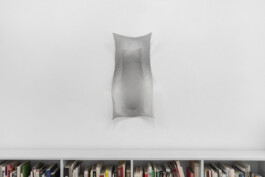
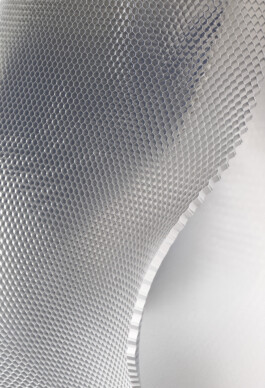
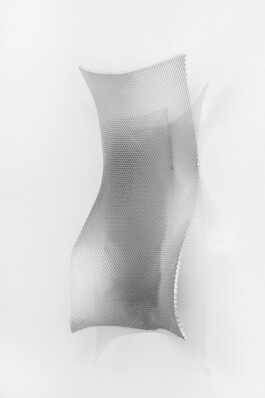
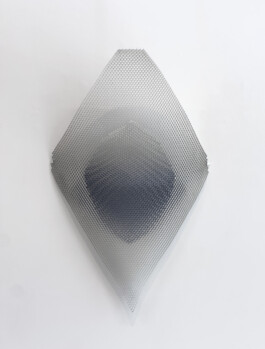
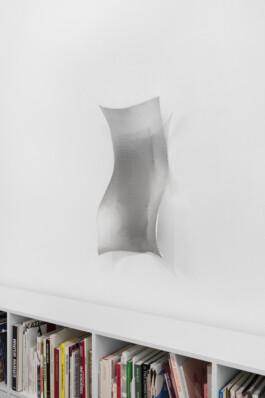
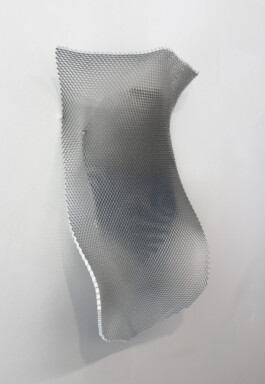
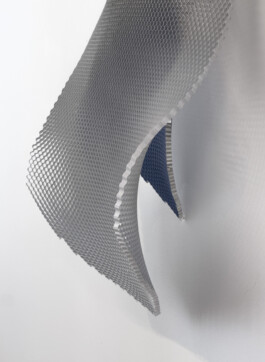
To Disappear, 2024
Aluminium Honeycomb, Spraypaint
cm 80 x 45

To Disappear, 2024
Aluminium Honeycomb, Spraypaint
cm 80 x 45
For her third solo exhibition at Live Gallery, Esther Mathis (b.1985) has created a series of works that encircle ideas of softness and strength, carapace and core. Each piece shows Mathis’s customary approach of metamorphosing commonplace industrial materials with light-handed yet assured gestures, into things of delicate beauty; carefully de-forming their functionality to create new forms in her ongoing inquiries into the nature of materials and the poetics of transformation.
The series «Liminal Bone» is the result of her experiments with polyester corrugated sheets - a common building material - here folded artfully into columns, catching the light inside, causing them to glow with an iridescent splendour. Suspended in these luminescent neo-classical pillars, are long lengths of aluminium netting -another ubiquitous industrial ingredient. Only half visible they have the undefined presence of smoke plumes, their gossamer form shielded like nerves encased in bone. The word ‘liminal’ comes from the Latin limen meaning ‘threshold’, Mathis’s work materialises thresholds in the search for new species of spaces, where the presence of physical properties lose their familiar certainty.
For «Second Skin» Mathis uses marble offcuts from a factory in Verona, small perfect cores of Carrera marble cut from the baseplates of Flos Arco lamps. In her hands these discarded pieces, remnants of an mass-produced aesthetic object, are reworked, permuted by processes that only Mathis could have imagined for them. Fascinated by nets, their pattens and uses, as intricate and malleable forms that impart strength, she wrapped the marble in nets of silver that she wove by hand. These she then oxidised, removing the nets to leave fragile green scrawls over the surface where the silver touched the stone, white stained with green, traces of a chemical embrace.
In the midst of this shifting geopolitical landscape, at a seemingly vertiginous historical moment where much of what was once considered stable is no longer to be relied upon, and old-fashioned ideas of strength are making a comeback, Mathis asks the question: What does it mean to be strong? Where do adaptability and gentleness become a strength?
«To Disappear», uses the hexagonal mesh from which she has previously manifested multiple works. Hung against a white wall, the parts sprayed white become almost indiscernible to the human eye, a reflection, she says, on thoughts about the unseen strength required to care for another human. All of these works have a human resonance. Buildings, and people, require structural reinforcements, to respond to a shifting fundament, be it emotional upheaval or seismic activity. We all bear the marks left by others, our form can often be defined by our function, like a spine the most vulnerable part of us is the source of our stability and strength, we all have to conceal some parts of ourselves to perform better, we are all indefinable at our core.
Leila Peacock


To Disappear, 2024
Aluminium Honeycomb, Spraypaint
cm 80 x 45
For her third solo exhibition at Live Gallery, Esther Mathis (b.1985) has created a series of works that encircle ideas of softness and strength, carapace and core. Each piece shows Mathis’s customary approach of metamorphosing commonplace industrial materials with light-handed yet assured gestures, into things of delicate beauty; carefully de-forming their functionality to create new forms in her ongoing inquiries into the nature of materials and the poetics of transformation.
The series «Liminal Bone» is the result of her experiments with polyester corrugated sheets - a common building material - here folded artfully into columns, catching the light inside, causing them to glow with an iridescent splendour. Suspended in these luminescent neo-classical pillars, are long lengths of aluminium netting -another ubiquitous industrial ingredient. Only half visible they have the undefined presence of smoke plumes, their gossamer form shielded like nerves encased in bone. The word ‘liminal’ comes from the Latin limen meaning ‘threshold’, Mathis’s work materialises thresholds in the search for new species of spaces, where the presence of physical properties lose their familiar certainty.
For «Second Skin» Mathis uses marble offcuts from a factory in Verona, small perfect cores of Carrera marble cut from the baseplates of Flos Arco lamps. In her hands these discarded pieces, remnants of an mass-produced aesthetic object, are reworked, permuted by processes that only Mathis could have imagined for them. Fascinated by nets, their pattens and uses, as intricate and malleable forms that impart strength, she wrapped the marble in nets of silver that she wove by hand. These she then oxidised, removing the nets to leave fragile green scrawls over the surface where the silver touched the stone, white stained with green, traces of a chemical embrace.
In the midst of this shifting geopolitical landscape, at a seemingly vertiginous historical moment where much of what was once considered stable is no longer to be relied upon, and old-fashioned ideas of strength are making a comeback, Mathis asks the question: What does it mean to be strong? Where do adaptability and gentleness become a strength?
«To Disappear», uses the hexagonal mesh from which she has previously manifested multiple works. Hung against a white wall, the parts sprayed white become almost indiscernible to the human eye, a reflection, she says, on thoughts about the unseen strength required to care for another human. All of these works have a human resonance. Buildings, and people, require structural reinforcements, to respond to a shifting fundament, be it emotional upheaval or seismic activity. We all bear the marks left by others, our form can often be defined by our function, like a spine the most vulnerable part of us is the source of our stability and strength, we all have to conceal some parts of ourselves to perform better, we are all indefinable at our core.
Leila Peacock
